

Traveling with a load and forklift stability is one of the most critical—and risky—parts of forklift operation. It only takes one mistake—a raised load, sharp turn, or uneven surface—to throw the forklift off balance and create a serious hazard.
That’s why proper forklift training and certification matter.
Certified operators learn how to move loads safely, recognize stability risks, and apply the right techniques every time they drive.
If you’re operating a forklift in Vancouver, Port Coquitlam, Surrey or any city, knowing how to travel with a load isn’t optional—it’s part of staying safe, staying compliant, and doing the job right.
Here’s what every trained and certified operator should know about traveling safely with a load.
One of the the most important procedures you should learn during forklift training—and something that needs to be reinforced during every certification course—is this: always travel with your load as low as safely possible.
The recommended height is 4 to 6 inches off the ground working inside, and 6-10 inches working outside.
Why is this important?
A low load lowers the combined center of gravity, keeping it well within the forklift’s stability triangle.
It reduces the risk drastically of any tip or rollover situations .
It improves operator visibility, helping you see hazards and pedestrians more clearly.
It puts less stress on the mast and tilt mechanisms during travel.
Travelling with raised forks create instability, and unfortunately is the number one bad habit that forklift operator pick up. If you’re moving a load from one place to another, the forks should always be down—only raise them when you’re machine is in a proper position for placing, lifting, or stacking.
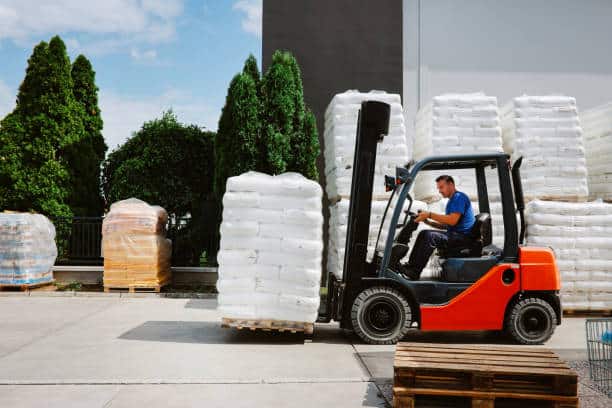
Always travel with the mast tilted slightly backward when carrying a load and unloaded. This small adjustment plays a big role in keeping the forklift stable.
Here’s why it matters:
It shifts the center of gravity toward the rear axle, where the forklift is most stable.
It secures the load against the load backrest and fork heel, preventing it from sliding or falling forward.
It reduces forward momentum of the load during stops or sudden changes in direction.
Even on smooth floors, a load can shift if it isn’t properly tilted. On uneven ground or ramps, that risk increases.
Tilting the load back improves stability—but too much tilt can create new problems.
Here’s why over-tilting is unsafe:
It raises the front of the load, when working in tight racking system’s for example, the potential for the load hitting the rack is increased.
On inclines or ramps, over-tilting shifts weight toward the rear, reducing traction and steering control.
It increases the height of the load, making it harder to see and more likely to hit overhead obstacles.
It can unbalance tall or uneven loads, especially if they’re not properly secured.
Your forklift stays upright because of one thing—balance. That balance depends on the stability triangle:
The two front wheels form the base.
The center of the rear axle forms the top point.
The combined center of gravity (forklift + the load) must stay within this triangle at all times.
If the center of gravity shifts outside that triangle, the forklift becomes unstable and can tip.
Common causes of instability include:
Heavy or off-center loads pulling the center forward
Sharp or fast turns shifting balance sideways
Uneven ground, ramps, or bumps disrupting forklift posture
Driving with a raised load, which raises the center of gravity
To keep your forklift stable:
Keep the load low and tilted slightly back
Make wide, slow turns
Avoid sudden direction changes
Center the load evenly on the forks
Slow down on slopes, and never turn on an incline
Ask yourself before you move:
Is the center of gravity still inside the triangle?
If you’re unsure, don’t guess. Adjust your load, your angle, or your route.
Staying inside the triangle keeps you safe. One small shift outside it can lead to serious consequences.

Confirm that:
The load is centered on both forks.
It’s not leaning or uneven.
Nothing is hanging off to one side.
A loose or unbalanced load can shift mid-transport. That can throw your whole forklift off balance.
Don’t move it until it’s stable and locked in.
Every forklift is built to carry a specific amount of weight—and that limit is there for a reason. Exceeding its lift capacity puts the operator and everyone around them at serious risk.
Start by checking the load capacity rating on the forklift’s nameplate (also called the data plate). This tells you the maximum weight the forklift can safely lift at a given load height and load center. It’s not a guess. It’s a safety limit based on physics and machine design. Always use a forklift with the proper lift capacity.

Driving a forklift isn’t just another task—it’s a responsibility. Every time you move a load, you’re making choices that affect your safety and the people around you.
You control more than just the forks. You control the outcome.
Do you slow down before a turn?
Keep your load low?
Pay attention to uneven ground?
These aren’t small details. They’re the difference between a safe shift and a serious incident.
No one’s perfect—but safe operators stay consistent. They pay attention. They don’t cut corners. And they understand that even routine movements require focus.
Every load matters.
Every decision counts.
And every safe move starts with you.